

How well do you actually know your spouse’s sexual likes, dislikes, boundaries, curiosities, and preferences?
Yes, No, Maybe is a comprehensive couples workbook designed to make those conversations easier. Rather than guessing what your spouse enjoys or waiting for an awkward moment to bring something up, each spouse works through structured questions and then compares answers without judgment, rejection, or pressure.
The guide begins by helping couples discuss the foundations of their sexual relationship, including consent, initiation, priorities, boundaries, sensitive and preferred areas of the body, health considerations, comfort, foreplay, aftercare, and sexual language. From there, the Yes, No, Maybe guide provides a simple framework for identifying what each spouse wants, does not want, or may be curious about discussing or exploring together.
The workbook concludes with guided reflection and discussion questions that help couples identify areas of mutual interest, talk through differences, recognize barriers to physical intimacy, and choose practical next steps together.
Whether you are preparing for marriage, have been married for decades, or simply want to understand your spouse better, Yes, No, Maybe provides a structured way to talk about sex with greater clarity, honesty, and confidence.
Length: 34 pages
By the Walther Institute for Marital Intimacy
Discover more of what feels good, where it feels good, and how you and your spouse can communicate about pleasure with greater confidence.
Pleasure Mapping is a guided, at-home exercise that helps spouses explore one another’s bodies with curiosity and intention. Rather than relying on assumptions or familiar routines, you will take turns exploring different types of touch, pressure, movement, texture, temperature, and sensory tools while learning to give and receive clear feedback.
Using included whole-body and genital diagrams, each spouse creates a personalized pleasure map that records areas and sensations that feel especially pleasurable, pleasant, neutral, or uncomfortable. The exercise encourages exploration of the entire body and helps couples discover not only where touch feels good, but how each person prefers to be touched.
Pleasure Mapping is designed to help you:
Discover overlooked or unexpected areas of pleasure
Learn your spouse’s preferences for different kinds of touch and sensation
Communicate more comfortably and specifically about what feels good
Replace assumptions with curiosity and real-time feedback
Develop a richer understanding of each other’s unique responses
Build skills that support greater connection and responsiveness during sexual intimacy
The goal is not orgasm or sexual performance. The goal is discovery.
Your completed maps provide a useful snapshot of what you learn, but the deeper value comes from practicing a different way of approaching intimacy: explore, notice, communicate, listen, and stay curious.
Includes: Step-by-step partner instructions, whole-body pleasure-mapping diagrams, genital pleasure-mapping diagrams, and guidance for exploring different types of touch and sensory stimulation.
This handout is priced at $0.99 to make practical clinical resources easily accessible to practitioners.
Note: This content is also included in the WIMI Private Journal for those who prefer full library access.
By the Walther Institute for Marital Intimacy
This handout is being made available for clinicians, coaches, and educators who want a practical, ready-to-use resource for introducing vulvar vibration therapy to clients.
Vulvar vibration therapy uses external vibration to support arousal, sensitivity, and orgasm. This client-facing guide presents a gradual approach that begins with indirect stimulation and progresses toward more direct stimulation as arousal and comfort increase.
Designed for clinical use, the handout translates the technique into straightforward instructions that clients can reference while practicing independently or incorporating the exercise into partnered intimacy.
Inside, clients are guided through:
The purpose and core principles of vulvar vibration therapy
How to set up a comfortable practice environment
A step-by-step progression from indirect to direct stimulation
How to use layering when vibration feels too intense
How to experiment with pressure, angle, positioning, and intensity
Strategies for building and maintaining stimulation toward orgasm
Techniques for managing overstimulation
What to expect when orgasm does not occur immediately
How the exercise can be incorporated into intimacy with a spouse
This is a no-fluff, implementation-ready resource clinicians can provide to clients who are working on arousal, sensitivity, or orgasm and would benefit from structured guidance for using vibration.
This handout is priced at $0.99 to make practical clinical resources easily accessible to practitioners.
Note: This content is also included in the WIMI Private Journal for those who prefer full library access.

By the Walther Institute for Marital Intimacy
This handout is being made available for clinicians, coaches, and educators who want a structured, ready-to-use guide for implementing Stage 5 of Sensate Focus with clients.
Stage 5 applies the attentional principles developed throughout Sensate Focus to intercourse. Rather than treating intercourse as the culmination or goal of the exercises, clients learn to approach it as another context for maintaining sensory awareness without reverting to performance, orgasm, timing, or other outcome-driven concerns.
Designed for clinical use, this handout gives clients practical guidance for incorporating intercourse while preserving the non-demand framework established in earlier stages.
Inside, clients are guided through:
The purpose and progression of Stage 5
How to approach intercourse as a sensory rather than goal-oriented experience
How to begin intercourse slowly and deliberately
The use of stillness, movement, withdrawal, and reentry to maintain sensory awareness
How to recognize the difference between exploratory and goal-directed movement
How to redirect attention away from performance, arousal, and orgasm
When to pause, simplify, or return to an earlier Sensate Focus stage
How Sensate Focus principles can eventually integrate into ordinary sexual activity
This is a no-fluff, implementation-ready resource that helps clients carry Sensate Focus into intercourse while maintaining the attentional skills developed throughout the earlier stages.
This handout is priced at $0.99 to make high-quality clinical tools easily accessible for practitioners.
Note: This content is also included in the WIMI Private Journal for those who prefer full library access.
By the Walther Institute for Marital Intimacy
This handout is being made available for clinicians, coaches, and educators who want a structured, ready-to-use guide for implementing Stage 4 of Sensate Focus with clients.
Stage 4 introduces mutual touching, increasing attentional complexity by having both partners touch and receive touch simultaneously. Clients practice shifting attention between what their hands experience while touching and what their bodies experience while being touched, while maintaining the same non-demand focus established in earlier stages.
Designed for clinical use, this handout provides clients with clear instructions for progressing into more complex sensory experiences without allowing the exercise to become performance-driven or goal-directed.
Inside, clients are guided through:
The purpose and progression of Stage 4
How mutual touching changes the attentional demands of Sensate Focus
How to shift attention between touching and being touched
The optional introduction of oral sensing as sensory exploration
How changing environments can introduce additional sensory input
Common challenges, including distraction and slipping into familiar sexual patterns
When to simplify the exercise by returning to one-directional touch
Practical guidance on boundaries, session length, frequency, and progression
This is a no-fluff, implementation-ready resource that helps clients strengthen their ability to maintain sensory attention as the Sensate Focus exercises become increasingly complex.
This handout is priced at $0.99 to make high-quality clinical tools easily accessible for practitioners.
Note: This content is also included in the WIMI Private Journal for those who prefer full library access.
By the Walther Institute for Marital Intimacy
This handout is being made available for clinicians, coaches, and educators who want a structured, ready-to-use guide for implementing Stage 3 of Sensate Focus with clients.
Stage 3 increases sensory complexity by introducing lotion or oil, allowing clients to practice attentional control under more varied and fluid tactile conditions. While the texture of touch changes, the core task remains the same: maintaining focus on physical sensation without shifting toward performance, arousal, or outcome.
Designed for clinical use, this handout helps clients deepen the foundational skill of attention while navigating increased distraction and sensory variation.
Inside, clients are guided through:
The purpose and progression of Stage 3
How increased sensory complexity strengthens attentional control
How to incorporate lotion without shifting into massage or goal-directed touch
What changes from Stage 2 and what remains consistent
How to recognize and redirect common distractions
Clear boundaries to preserve the non-demand structure of the exercise
Practical guidance on session length, frequency, and progression
This is a no-fluff, implementation-ready resource that helps clients refine attentional discipline as sensory input becomes more dynamic and potentially distracting.
This handout is priced at $0.99 to make high-quality clinical tools easily accessible for practitioners.
Note: This content is also included in the WIMI Private Journal for those who prefer full library access.
By the Walther Institute for Marital Intimacy
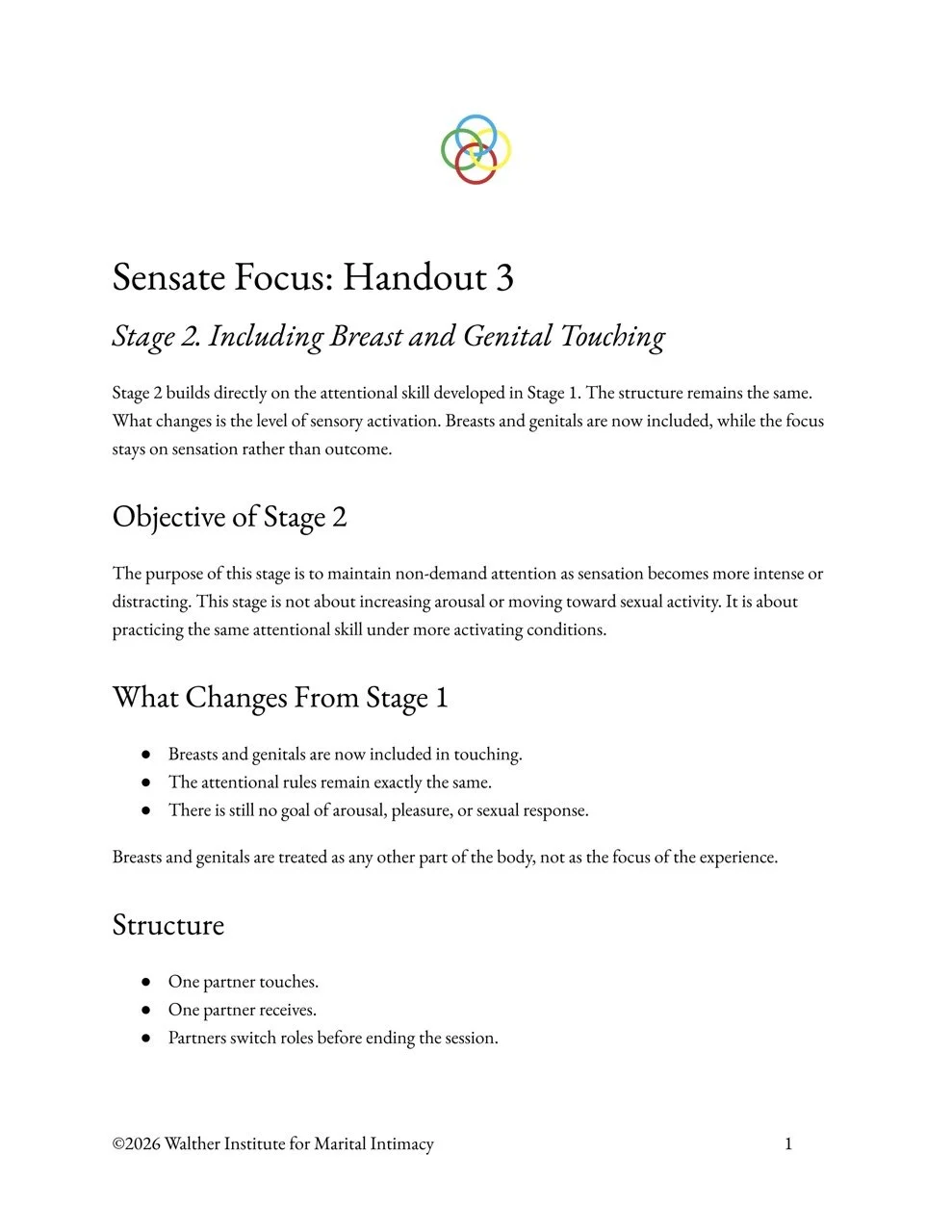
This handout is being made available for clinicians, coaches, and educators who want a clear, structured guide for implementing Stage 2 of Sensate Focus with clients.
Stage 2 builds directly on the attentional skill developed in Stage 1, introducing a higher level of sensory activation by including breasts and genitals while maintaining the same non-demand focus on physical sensation. The emphasis remains on attention, not arousal, performance, or outcome.
Designed for clinical use, this handout equips clients to continue progressing between sessions with minimal confusion or misapplication.
Inside, clients are guided through:
The purpose and progression of Stage 2
What changes from Stage 1 and what remains the same
How to include breasts and genitals without shifting into goal-directed touch
The roles of toucher and receiver under increased sensory intensity
The use of hand-riding as a nonverbal communication tool
Common challenges such as distraction, arousal monitoring, and outcome focus
Clear boundaries to maintain the integrity of the exercise
Practical guidance on session structure, duration, and progression
This is a no-fluff, implementation-ready resource that helps clients maintain attentional discipline as intensity increases, which is essential for successful progression through Sensate Focus.
This handout is priced at $0.99 to make high-quality clinical tools easily accessible for practitioners.
Note: This content is also included in the WIMI Private Blog for those who prefer full library access.
By the Walther Institute for Marital Intimacy
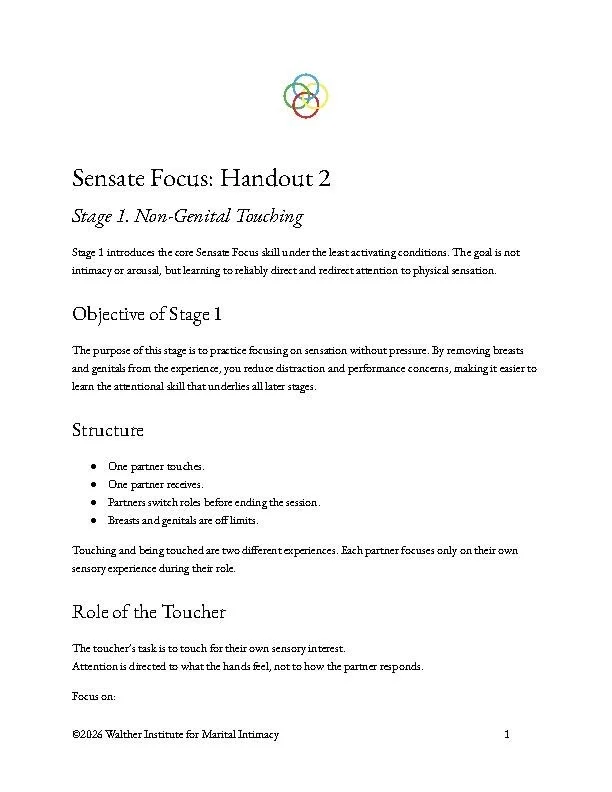
This handout is being made available for clinicians, coaches, and educators who want a structured, ready-to-use guide for implementing Stage 1 of Sensate Focus with clients.
Stage 1 introduces the core attentional skill of Sensate Focus under controlled, low-pressure conditions. By removing breasts and genitals from the experience, this stage minimizes performance anxiety and allows clients to learn how to reliably direct attention to physical sensation.
Designed for clinical application, this handout provides clear instructions that clients can follow independently between sessions, reducing the need for repeated explanation and improving adherence.
Inside, clients are guided through:
The purpose and structure of Stage 1
The distinct roles of toucher and receiver
How to focus attention on sensation (temperature, pressure, texture)
How to handle distraction without disrupting the exercise
Practical guidelines for session length, frequency, and progression
How to properly end sessions without reinforcing performance evaluation
This is a no-fluff, implementation-ready resource that helps clients build the foundational skill required for all later stages of Sensate Focus.
This handout is priced at $0.99 to make high-quality clinical tools easily accessible for practitioners.
Note: This content is also included in the WIMI Private Journal for those who prefer full library access.
By the Walther Institute for Marital Intimacy
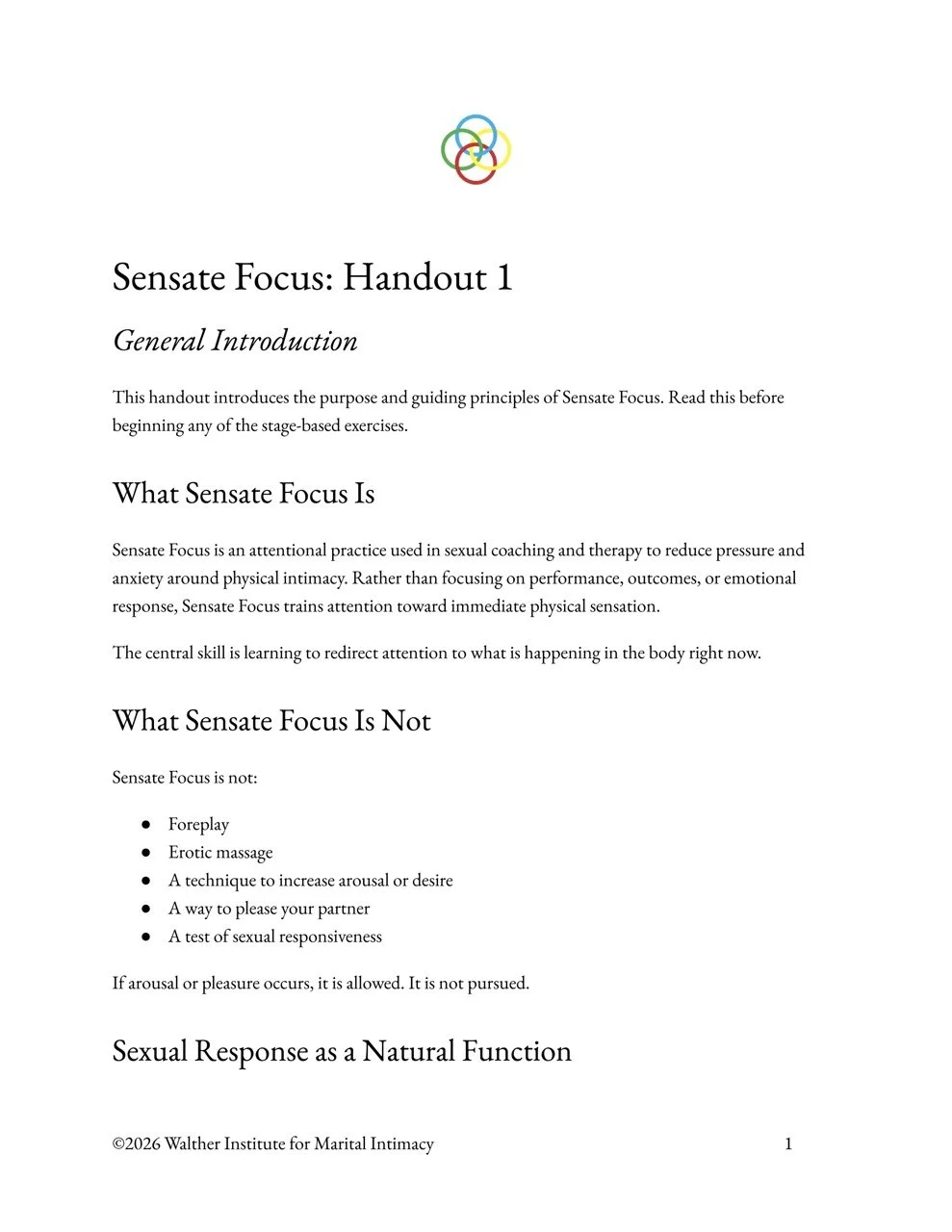
This handout is being made available for clinicians, coaches, and educators who want a clear, structured introduction to Sensate Focus to use with their clients.
Sensate Focus is a widely used intervention in sexual therapy for reducing anxiety, performance pressure, and over-monitoring during physical intimacy. This handout presents the core framework in concise, accessible language that clients can easily understand and apply.
Designed for clinical use, this resource can be assigned as pre-session reading, used to support psychoeducation, or provided alongside stage-based Sensate Focus exercises.
Inside, clients will learn:
What Sensate Focus is and what it is not
Why effort and control interfere with sexual response
The central paradox underlying arousal and pleasure
How to shift attention toward physical sensation
The universal guidelines that govern all stages
This is a no-fluff, ready-to-use tool you can immediately integrate into your work.
This handout is priced at $0.99 to make it easily accessible for practitioners who want high-quality, clinically grounded materials without unnecessary cost barriers.
Note: This content is also included in the WIMI Private Journal for members who prefer full library access.
Most married couples are not struggling because they lack love or attraction. They struggle because they lack clarity.
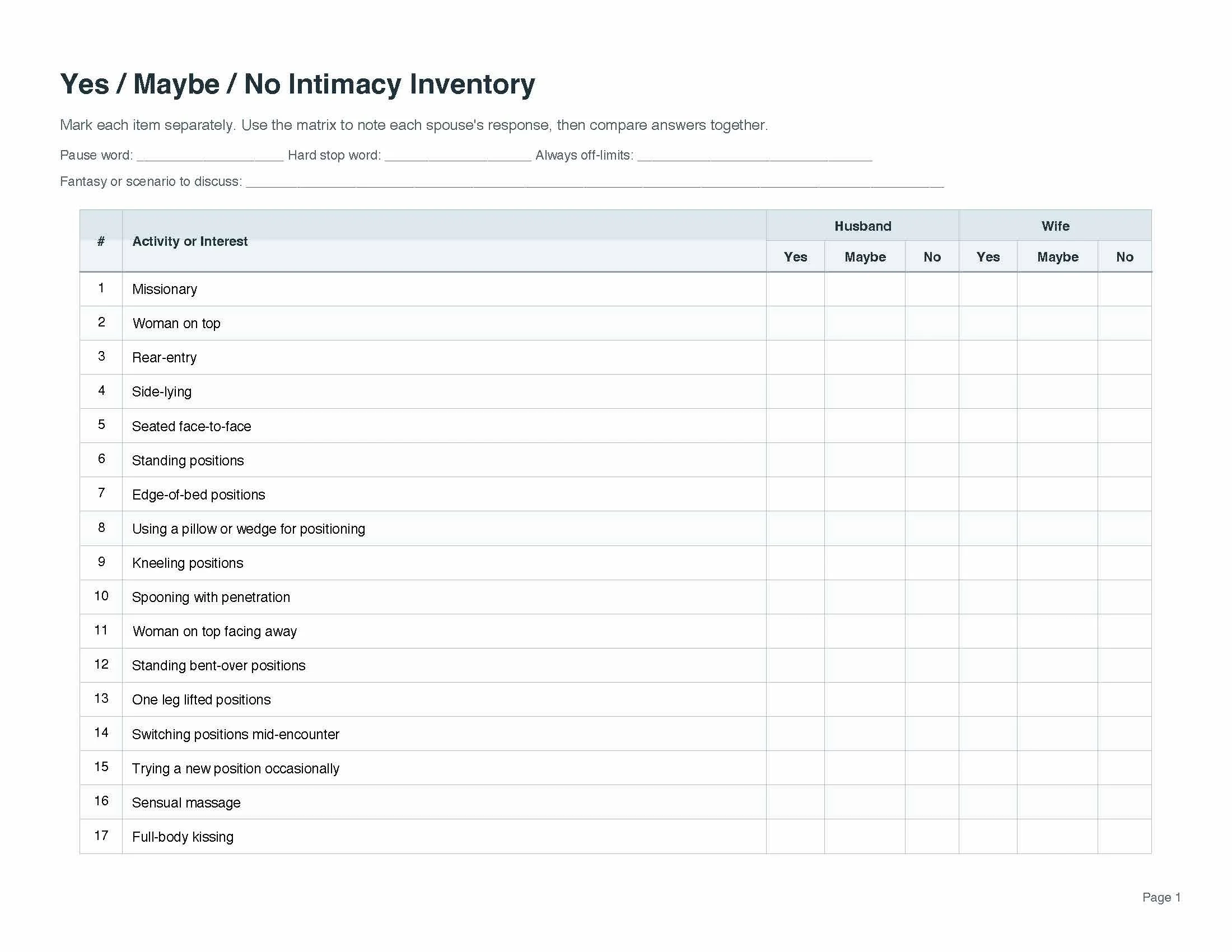
The Yes / Maybe / No Intimacy Inventory is a simple but powerful tool designed to help couples move from uncertainty to confident, respectful communication about their sexual relationship.
Instead of awkward conversations or guessing what your spouse might want, this guided worksheet allows each spouse to privately reflect and then compare answers in a calm, structured way. The result is greater understanding, fewer assumptions, and a clearer path forward.
This inventory walks couples through a wide range of areas, including:
Positions and physical dynamics
Types of touch and stimulation
Pacing and style preferences
Settings and atmosphere
Toys and accessories
Erotic novelty and power dynamics
Each item is marked as Yes, Maybe, or No, helping couples quickly identify:
Shared interests (where to start)
Areas of curiosity (where to explore carefully)
Clear boundaries (where to respect and move on)
This is not a test, a demand list, or a performance checklist. It is a communication tool designed to:
Reduce tension around sexual conversations
Build mutual understanding
Increase confidence and honesty
Help couples grow their intimacy at a sustainable pace
Used well, this inventory becomes a repeatable framework couples can return to over time as comfort, trust, and openness develop.
No results match your search. Try removing a few filters.