Overview
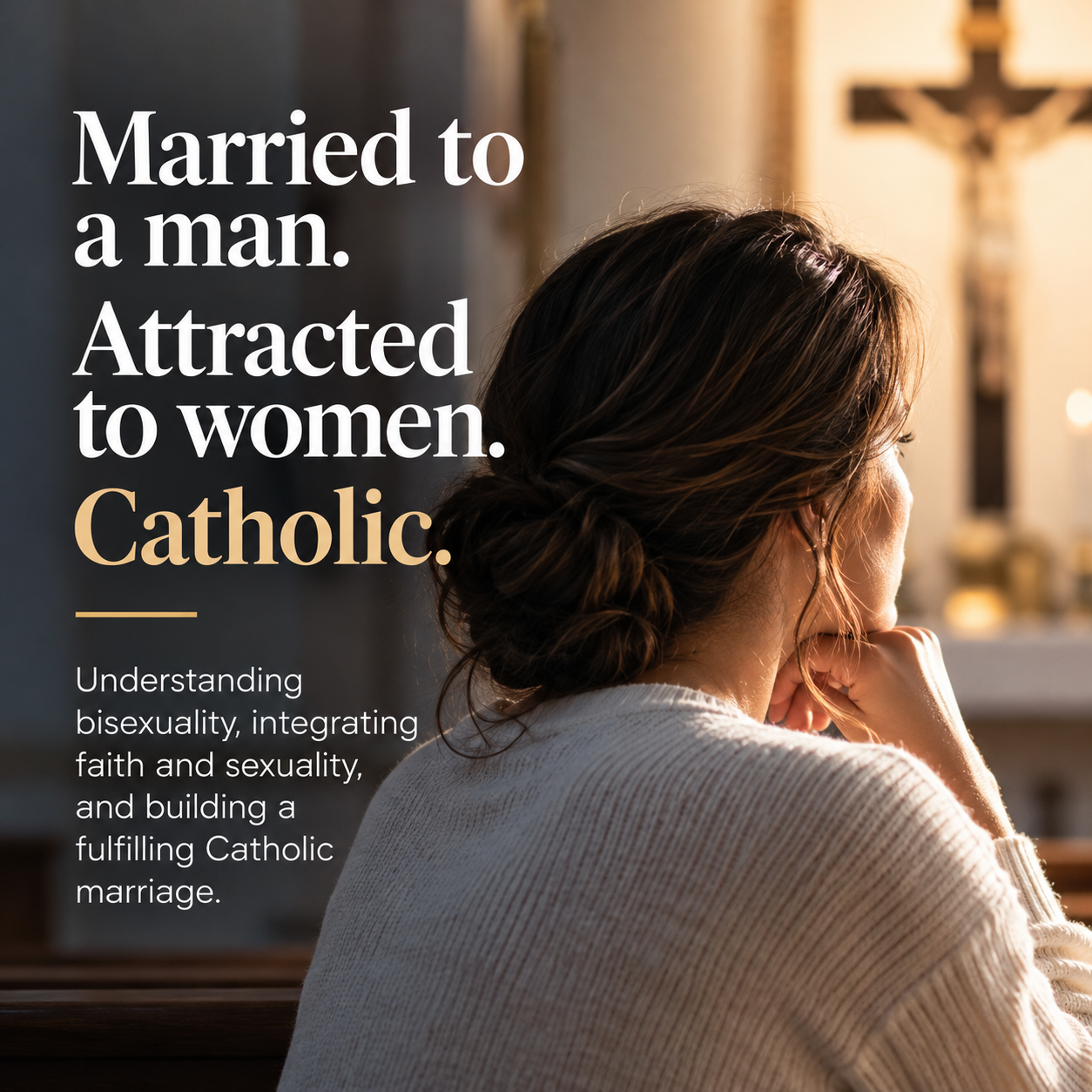
Married to a man, attracted to women, and committed to your Catholic faith? These experiences are not mutually exclusive. Explore how bisexual Catholic women can embrace their sexuality, strengthen emotional and sexual intimacy with their husbands, and build fulfilling marriages rooted in faith, self-understanding, and mutual respect.
Understanding bisexuality, integrating faith and sexuality, and cultivating a fulfilling Catholic marriage
You love your husband. You are committed to your marriage. Your Catholic faith is an important part of your life.
And you're attracted to women.
Perhaps you've known this about yourself since adolescence. Maybe you had a girlfriend before meeting your husband. Perhaps you've been sexually intimate with women in the past. Or maybe you've never had a relationship with another woman, but you've experienced attractions that you haven't quite known how to understand.
You may genuinely desire your husband and enjoy your sexual relationship with him. Yet your attraction to women remains part of your experience.
Where does that leave you as a Catholic wife?
For some women, the answer seems simple: Don't act on those attractions, and there's nothing more to discuss.
But sexuality is more complicated than that. Sexual attraction involves more than the behaviors we choose. It can influence how we understand ourselves, experience desire, remember previous relationships, and connect with our spouses.
Acknowledging these experiences does not mean abandoning your faith or marriage. It means recognizing that your sexuality deserves thoughtful attention rather than silence.
Bisexuality Doesn't Disappear When You Get Married
One of the most persistent misunderstandings about bisexuality is that a person's sexual orientation is determined by their current relationship.
A bisexual woman married to a man may be assumed to be heterosexual. If she previously dated women, others might describe those relationships as a phase. If she enjoys sex with her husband, people may wonder why her attraction to women matters anymore.
But bisexuality does not require equal attraction to men and women, a history of sexual relationships with both, or an ongoing desire to pursue multiple partners.
Sexual orientation, sexual behavior, and relationship commitment are related but distinct aspects of sexuality.
Research on bisexual identity helps illustrate why these distinctions matter. Pew Research Center (2024) reported that 5% of American women identified as bisexual in its 2023 survey, including 16% of women under age 30. These figures do not tell us how many Catholic women experience bisexual attraction, but they challenge the assumption that bisexuality among women is exceptionally rare.
Research also suggests that bisexual women partnered with men may experience a particular form of invisibility because others assume they are heterosexual (Ross et al., 2017).
For a Catholic wife, that invisibility may be especially complicated. She may wonder whether discussing her attractions will cause her husband to question her commitment, whether other Catholics will misunderstand her, or whether a therapist will dismiss her religious convictions.
She may consequently avoid discussing something that remains personally meaningful.
Being married to a man does not invalidate a woman's bisexuality. Neither does bisexuality invalidate her marriage.
When Silence Becomes Isolation
Imagine being a woman who has spent years trying to understand her attraction to other women.
You may have experienced a meaningful romantic relationship with another woman before your marriage. You may remember the emotional and physical intimacy of that relationship with a mixture of affection, regret, grief, or confusion.
Alternatively, you may never have acted on your attractions. They may simply be something you've quietly carried throughout your life.
You might hesitate to discuss these experiences because you're concerned about how others will respond.
Will your husband feel inadequate? Will someone question your faith? Will a therapist encourage you to abandon beliefs that are important to you?
These concerns can make an already personal subject feel impossible to discuss.
Research on mixed-orientation marriages has examined the complicated relationship between openness, secrecy, and marital intimacy (Adler & Ben-Ari, 2017). Although that study focused on gay and bisexual men married to women, it illustrates why disclosure cannot be reduced to a simple instruction to reveal everything immediately.
For some couples, thoughtful conversations about sexuality create opportunities for greater understanding. For others, disclosure requires preparation, emotional safety, and careful attention to the relationship's existing difficulties.
Silence is not always unhealthy, and privacy is not necessarily secrecy. However, when a woman feels unable to acknowledge an important part of herself, she may experience loneliness, shame, or emotional distance.
The goal is not to force disclosure. It is to create an environment in which she can understand her experiences and make thoughtful decisions about what to share, when to share it, and how.
Acknowledging Your Sexuality Is Not the Same as Acting on Every Attraction
One of the most important distinctions in integrating sexuality and faith is recognizing the difference between experiencing attraction and choosing sexual behavior.
All married people encounter attractions, desires, and fantasies that they do not necessarily act upon. Fidelity involves making choices about how we respond to those experiences.
For a bisexual Catholic woman, however, the question may involve more than marital fidelity. She may also be trying to understand the moral significance of her attractions and how they relate to her religious identity.
She does not have to deny that she finds women attractive to choose a monogamous marriage with her husband.
Nor must she pursue relationships with women to establish that her bisexuality is real.
An integrated sexuality begins with honest self-understanding. That includes recognizing attractions without assuming that every attraction must determine one's behavior.
It also means making room for complicated emotions. A woman may experience grief about a previous relationship, curiosity about experiences she has never had, or uncertainty about how her sexuality fits into her life.
Those experiences deserve exploration rather than automatic judgment.
The objective is not to eliminate bisexual attraction. It is to help a woman understand her sexuality and make informed, freely chosen decisions about how she wishes to live.
What Does the Catholic Church Actually Teach?
For Catholic women, meaningful sexual integration requires an accurate understanding of Church teaching.
The Catechism of the Catholic Church distinguishes between same-sex attraction and sexual behavior. It teaches that sexual acts between people of the same sex are morally impermissible while also calling for people who experience same-sex attraction to receive respect, compassion, and sensitivity (Catholic Church, 1997, §§ 2357–2359).
The Catechism also describes chastity as the successful integration of sexuality within the person (§ 2337).
This concept is especially relevant to women trying to understand bisexuality within Catholic marriage.
Chastity is not simply the absence of prohibited sexual behavior. Within Catholic moral theology, it concerns the integration of sexuality with the whole person, including one's commitments, relationships, and moral responsibilities.
For married Catholics, the Church understands sexual intimacy as an expression of conjugal love, involving both the unitive and procreative meanings of marriage (Catholic Church, 1997, §§ 2360–2363).
These teachings establish moral boundaries for Catholics seeking to live in accordance with the Church. They do not mean that every aspect of a woman's sexual experience is reducible to whether a particular sexual act is permitted.
A woman may have important questions about identity, attraction, affection, memory, desire, and personal growth that deserve thoughtful exploration.
Catholic teaching also affirms the dignity of every person. The United States Conference of Catholic Bishops (2006) explicitly emphasizes that people experiencing same-sex attraction must be treated with respect and must not become targets of hatred or unjust discrimination.
A woman's experience of bisexuality does not diminish her human dignity or make her unworthy of love, compassion, or meaningful clinical support.
In therapy, the objective is to help her explore how these teachings relate to her life while respecting her conscience, autonomy, and freely chosen religious commitments.
Your Husband Needs to Understand This Part of You, Too
Although a woman may initially experience these questions as deeply personal, bisexuality can also become an important topic within her marriage.
Her husband may have questions of his own.
Does her attraction to women mean that she finds him less attractive? Is she dissatisfied with their sexual relationship? Does she miss being with women? Is there something he cannot provide?
These questions may arise from genuine uncertainty rather than hostility.
A helpful starting point is recognizing that attraction to women does not automatically imply dissatisfaction with a male partner.
A bisexual woman can find her husband physically attractive, experience genuine sexual desire for him, and enjoy a deeply satisfying marital relationship.
At the same time, her attraction to women may remain meaningful to her.
Husbands need not interpret this as a competition they are destined to lose.
Instead, couples can begin asking more constructive questions:
What does bisexuality mean to my wife personally?
How has she experienced and understood her attractions throughout her life?
Are there experiences, fears, or memories that she has never felt comfortable discussing?
How can we talk about sexuality without either spouse feeling judged, dismissed, or threatened?
What would greater emotional and sexual intimacy look like for our marriage?
These conversations require patience and mutual respect.
The wife should not feel pressured to minimize her sexuality to protect her husband from discomfort. Likewise, the husband deserves space to process his own feelings without being automatically characterized as insecure or unsupportive.
Both spouses bring legitimate emotional experiences into the conversation.
The goal is not to determine which spouse is right. It is to develop greater understanding and strengthen the relationship.
Building a Satisfying Sexual Relationship Within Marriage
An especially overlooked aspect of this discussion is sexual satisfaction.
A woman may feel that because she enjoys sex with her husband, her bisexuality should have no further relevance to their sexual relationship.
But satisfying marital sexuality involves more than the ability to become aroused or experience orgasm.
It also involves feeling understood, desired, emotionally connected, and comfortable communicating about pleasure.
For some bisexual women, previous relationships with women may have influenced their understanding of sexual pleasure, affectionate touch, pacing, or emotional connection.
For others, attraction to women may have little direct influence on what they enjoy sexually with their husbands.
There is no single bisexual sexual experience, and clinicians should not assume that a woman's orientation predicts her sexual preferences.
Instead, couples can explore her individual experience.
What types of touch does she enjoy? What helps her experience arousal? Does she feel comfortable communicating her preferences? Are there aspects of intimacy she would like to experience differently?
These conversations can help both spouses become more attentive to one another.
They can also challenge the assumption that the husband should instinctively know what satisfies his wife or that she should simply accept whatever sexual routine has developed within their marriage.
Sexual intimacy is something spouses can continue learning and developing together.
Within a Catholic framework, these discussions can respect the couple's religious commitments while helping them explore mutually acceptable ways of expressing affection, experiencing pleasure, and strengthening their sexual relationship.
Importantly, no sexual activity should become an obligation imposed on either spouse. Healthy marital intimacy requires mutual consent, respect, and attention to each person's dignity.
The objective is not to reproduce a woman's previous relationships or suggest that her husband must somehow replace a female partner.
It is to help this particular couple discover how to cultivate a fulfilling sexual relationship with one another.
Integrating Bisexuality, Faith, and Marriage
Sexual integration does not mean that every desire must be fulfilled.
Nor does it mean that every attraction must disappear.
Instead, integration involves developing an honest and coherent understanding of one's sexuality and how it relates to the rest of one's life.
For a married Catholic woman, that may involve several dimensions of personal growth.
Self-understanding: Recognizing her bisexuality without treating it as something shameful or requiring correction.
Emotional integration: Processing previous relationships, attractions, unresolved grief, or experiences that have shaped her understanding of intimacy.
Spiritual integration: Exploring how her sexuality relates to her relationship with God, her understanding of Catholic teaching, and her personal commitments.
Marital integration: Developing honest communication, mutual understanding, and a satisfying relationship with her husband.
These dimensions are interconnected.
A woman who feels unable to discuss her sexuality may struggle to feel fully understood by her spouse. A couple who avoids conversations about sexual pleasure may miss opportunities to strengthen physical intimacy. Religious uncertainty may contribute to emotional distress when a woman believes that experiencing attraction itself makes her a bad Catholic.
Therapeutic work can help identify and address these difficulties without assuming that bisexuality is inherently problematic.
The aim is not to make the woman less bisexual or less Catholic.
It is to help her live with greater self-understanding, emotional well-being, and relational authenticity.
How Specialized Couples Therapy Can Help
At the Walther Institute for Marital Intimacy, we recognize that Catholic couples navigating bisexuality may need a therapeutic environment that understands both the complexity of human sexuality and the importance of their religious commitments.
This is an area where generic relationship advice may fall short.
Some couples need help discussing attractions that have never been openly acknowledged. Others are working through previous same-sex relationships, sexual dissatisfaction, shame, or differences in how spouses understand Catholic teaching.
Still others have healthy marriages but want to develop greater intimacy and understanding.
Our approach emphasizes couples therapy because these concerns often involve both personal experiences and relational dynamics.
During the initial assessment, we explore each spouse's concerns, the couple's relationship history, their goals, and whether conjoint therapy is appropriate.
When a husband is unwilling or unable to participate, individual therapy may also provide an opportunity for a woman to explore her experiences and develop greater self-understanding.
This is not conversion therapy.
We do not attempt to change a woman's sexual orientation, eliminate same-sex attraction, or treat bisexuality as a mental disorder.
Our work focuses on helping clients understand their sexuality, process difficult emotions, strengthen communication, and make informed decisions about their relationships and values.
We also recognize that clients differ in how they understand and practice their Catholic faith. Therapy provides space for thoughtful exploration rather than imposing predetermined personal conclusions.
For couples who freely choose to structure their marriage and sexual lives according to Catholic teaching, we can help them explore how to pursue meaningful intimacy within those commitments.
The measure of successful therapy is not whether a woman's attractions change. It is whether she and her husband can move toward their chosen goals with greater understanding, emotional health, and relational connection.
You Do Not Have to Navigate This Alone
Being married to a man, attracted to women, and committed to the Catholic faith can raise questions that are difficult to discuss.
But those experiences are not mutually exclusive.
You can love your husband and still experience attraction to women.
You can value Catholic teaching while seeking a deeper understanding of your sexuality.
You can acknowledge your experiences without assuming that every attraction must become an action.
And you can pursue a satisfying sexual relationship with your husband while continuing to grow in your understanding of yourself.
You do not have to pretend that part of your sexuality does not exist.
A fulfilling Catholic marriage does not require you to stop asking questions about who you are.
If you and your husband would benefit from a supportive environment to explore these concerns, specialized couples therapy may be an opportunity to begin that conversation.
The Walther Institute for Marital Intimacy welcomes inquiries from Catholic couples seeking help integrating faith, sexuality, and marital intimacy.
Contact the Archangel Catholic and ask for James Walther to learn more about specialized couples therapy and available services.
References
Adler, A., & Ben-Ari, A. (2017). The myth of openness and secrecy in intimate relationships: The case of spouses of mixed-orientation marriage. Journal of Homosexuality, 64(6), 804–824. https://doi.org/10.1080/00918369.2016.1236585
American Psychological Association. (2009). Report of the American Psychological Association Task Force on Appropriate Therapeutic Responses to Sexual Orientation. https://www.apa.org/pi/lgbt/resources/sexual-orientation
Catholic Church. (1997). Catechism of the Catholic Church (2nd ed.). Libreria Editrice Vaticana. https://www.vatican.va/content/catechism/en.html
Pew Research Center. (2024, June 28). For Pride Month, 6 facts about bisexual Americans. https://www.pewresearch.org/short-reads/2024/06/28/for-pride-month-6-facts-about-bisexual-americans/
Ross, L. E., et al. (2017). Male-partnered sexual minority women: Sexual identity disclosure to health care providers during the perinatal period. https://pmc.ncbi.nlm.nih.gov/articles/PMC5473657/
United States Conference of Catholic Bishops. (2006). Ministry to persons with a homosexual inclination: Guidelines for pastoral care. https://www.usccb.org/committees/doctrine/general-principles
